
The Definitive Guide to Vitiligo Tattooing
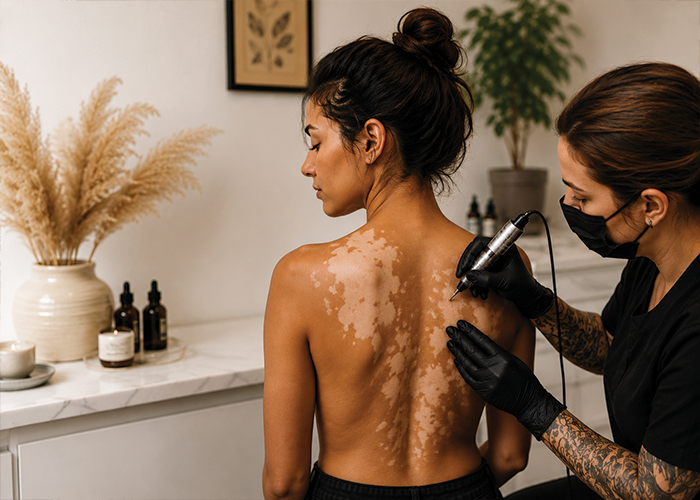
Vitiligo is more than just a dermatological condition; for many, it is a journey of navigating self-consciousness and the desire for skin uniformity. Characterized by a loss of pigment that results in milky-white patches, vitiligo can affect any part of the body. While physically harmless, the psychological weight of the condition can be profound. At Ink du Soleil, we specialize in a sophisticated field of cosmetic artistry known as medical micropigmentation or skin camouflage.
Our mission is to bridge the gap between medical science and fine-art precision. By expertly depositing custom-blended pigments into depigmented areas, we help our clients reclaim their confidence and achieve a more uniform appearance. If you have been searching for a Vitiligo Tattoo Near Me, our studio provides the expert care and technical mastery required for this delicate restorative work.
Understanding the Art of Vitiligo Camouflage
Vitiligo tattooing, also referred to as skin repigmentation, is the intricate process of implanting specialized, skin-toned pigments into the dermis to mimic the natural color of your surrounding tissue. Unlike traditional tattooing, which often relies on bold saturations and defined edges, vitiligo camouflage at
The Process: Precision and Artistry at Ink du Soleil
Achieving a flawless color match is a gradual journey that requires immense patience and attention to detail. At
The Advantages of Vitiligo Tattooing
For those seeking a Vitiligo Tattoo Bc, this procedure can be truly life-changing. Here are the primary benefits:
- Boosted Self-Confidence: The primary advantage is psychological relief. Clients often report feeling less “on display” and more comfortable in both social and professional environments.
- Time-Saving Solution: Many individuals spend hours every morning applying heavy camouflage makeup or “Dermablend.” Tattooing provides a semi-permanent base that significantly reduces or entirely eliminates the need for daily coverage.
- Waterproof and Life-Proof: Unlike topical creams, a vitiligo tattoo is smudge-proof and waterproof. It will not rub off on clothing, fade during a workout, or wash away in a swimming pool.
- Natural Appearance: When performed by the experts at Ink du Soleil, the results are incredibly subtle. To the casual observer, the tattoo is invisible; they simply see healthy, uniform skin.
Potential Disadvantages and Realities
As with any medical-cosmetic procedure, it is vital to maintain realistic expectations regarding the limitations of skin camouflage.
- Sun Sensitivity and Tanning: This is the most significant consideration. Tattoo pigment does not contain melanin and therefore does not tan. If you spend time in the sun and your natural skin darkens, the tattooed area will remain the same color, potentially making it appear lighter than the surrounding skin. We strongly advise the daily use of high-SPF sunscreen.
- Maintenance and Fading: These are semi-permanent procedures. Over 2 to 5 years, the pigment will naturally fade as skin cells regenerate. Periodic “color boosts” are necessary to maintain the color match.
- Texture Differences: While we can match color, tattooing cannot alter the texture of the skin. If the depigmented patch has a different texture than the surrounding skin, it may still be slightly visible upon very close inspection under certain angles of light.
Why Trust Ink du Soleil for Your Camouflage?
Medical tattooing requires a vastly different skill set than traditional body art. It demands a profound understanding of skin anatomy, color science, and the biology of wound healing. At
Frequently Asked Questions (FAQs)
We prioritize your comfort by applying a highly effective topical numbing cream before and during the session. Most clients describe the sensation as a light vibration or a gentle tickling rather than pain. If you are looking for a Vitiligo Tattoo Bc, you will find our process much more comfortable than a standard tattoo.
No. We only perform tattooing on stable vitiligo that is no longer spreading. We also generally avoid the palms of the hands and the soles of the feet, as the skin in these areas regenerates too quickly to retain pigment effectively.
Initial healing usually takes 7 to 10 days. During this period, the treated area may appear darker or slightly crusty. While the surface heals quickly, the final color develops over approximately six weeks. If you're searching for a Vitiligo Tattoo Near Me, proper aftercare is essential for the best results.
The Koebner Phenomenon is a skin reaction where new vitiligo patches can develop after skin trauma, including tattooing. That's why Ink du Soleil carefully evaluates your skin condition and only treats stable cases to help reduce potential risks during your Vitiligo Tattoo BC procedure.
Vitiligo tattooing is considered semi-permanent. The specialized pigments are designed to blend naturally with your skin and gradually fade over time. Most clients require a touch-up every 3 to 5 years to maintain the appearance, making it a popular choice for Best Vitiligo Tattoo Maple Ridge services.
Claim Your Confidence: Book Your Consultation
Blending art and science to reveal the real you—Book your restorative session at Ink du Soleil today.